2025 California Cannabis Cultivation Insights Report
Insights on the cultivation sector of the California Cannabis Industry, from 2018 to 2026. Covers trends in indoor, outdoor, and mixed light by county, as well as license counts, large licenses, and major businesses.
Higher OriginsPublished Feb 17, 2026 · Updated Sep 27, 2026 · 14 min read
It’s been a while since we took an in-depth look at the numbers for the California cannabis industry. For several years, we did quarterly reports on the state of the industry and trends in licensing, regional growth, and cultivation. After a hiatus for 2025, we’re back with a full summary of what happened last year and since legalization. This will be the first of three reports published separately. This one is about the cultivation industry, while the second will be about the commercial side of the industry, and the last one will be on manufacturing. All of this information is collected from publicly available data in the State License Search. If you are trying to do your own research or need some more in depth information, you can use our improved version of the state license search here, now with additional graphs and data visible under the “Summarize Licenses” button. Without further ado, let’s get into the data for 2025!
Overall Cultivation Since Inception
Let’s start with a basic overview of the scale of the cultivation sector since licensing began in 2018.
Cultivation Licenses Since Inception
Annual active cultivation license totals are grouped by indoor, mixed-light, and outdoor environment.
View chart data
Observation period
Outdoor
Mixed light
Indoor
2018
2
0
1
2019
2,247
1,542
515
2020
3,426
2,164
728
2021
5,425
2,497
816
2022
6,057
2,498
1,011
2023
4,752
1,950
1,027
2024
3,248
1,480
982
2025
2,894
1,275
1,004
Jan 31, 2026
2,401
1,006
921
California Department of Cannabis Control license records maintained by Higher Origins. Frozen for this article; includes hidden-status and non-public records and excludes deleted records. · Data frozen Sep 27, 2026 4:22 AM PDT
The largest license category is outdoor cultivation, which grew steadily from legalization and peaked in 2022. No mixed light was licensed at all in the first year, but it quickly shot up to second place, peaking in 2021. Indoor has been much more stable and grown more slowly, gradually leveling off from 2022-2025. Cultivation is in decline across all grow styles. Here’s a table of the year-over-year change percentages since 2019 when meaningful growth began.
Year-over-Year Change of Active Cultivation Licensing
The matrix compares each complete calendar year's active cultivation licenses with the prior year by cultivation environment.
View chart data
Observation period
Outdoor
Mixed light
Indoor
2019
112250%
100%
51400%
2020
52%
40%
41%
2021
58%
15%
12%
2022
12%
0%
24%
2023
-22%
-22%
2%
2024
-32%
-24%
-4%
2025
-11%
-14%
2%
Loss from peak
-52%
-49%
-2%
California Department of Cannabis Control license records maintained by Higher Origins. Frozen for this article; includes hidden-status and non-public records and excludes deleted records. · Data frozen Sep 27, 2026 4:22 AM PDT
Let’s look at this from a slightly different angle. Licensing is one way to track cultivation, but it doesn’t tell the whole story. Since there are different kinds of cultivation licenses that allow different sizes of canopy, the number of licenses doesn’t tell the whole story. This is why we prefer to track cultivation via square footage.
For example: County A has 10 licenses, and County B has two. If you only look at license counts, you could assume that County A had a larger crop. In fact, County A only has specialty cottage indoor licenses with up to 500 square feet of canopy, while County B has two medium indoor licenses with up to 10,000 square feet of canopy. Therefore, County A has 1/4th the canopy, despite having 5 times the amount of licenses.
Square Footage of Active Cultivation Since Inception
Annual active cultivation square footage is grouped by indoor, mixed-light, and outdoor environment.
View chart data
Observation period
Outdoor
Mixed light
Indoor
2018
10,000 ft²
0 ft²
5,000 ft²
2019
33,350,000 ft²
15,292,000 ft²
4,372,500 ft²
2020
50,807,940 ft²
21,556,000 ft²
6,056,500 ft²
2021
79,947,160 ft²
25,178,000 ft²
7,128,500 ft²
2022
90,116,720 ft²
25,275,000 ft²
9,398,000 ft²
2023
78,399,000 ft²
19,885,000 ft²
9,675,000 ft²
2024
67,266,480 ft²
15,407,000 ft²
9,618,000 ft²
2025
68,383,660 ft²
13,872,000 ft²
10,304,000 ft²
Jan 31, 2026
61,139,760 ft²
10,790,000 ft²
9,673,000 ft²
California Department of Cannabis Control license records maintained by Higher Origins. Frozen for this article; includes hidden-status and non-public records and excludes deleted records. · Data frozen Sep 27, 2026 4:22 AM PDT
When looking at square footage, the chart is almost the same, except that outdoor cultivation consists of much more canopy than the license count would suggest. The trendlines are similar, just scaled proportionally to the amount of available canopy.
Cultivation by County
Let’s break cultivation down across counties. Since California has 58 counties with varying population, politics, and geography, the county level view makes sense for exploring regional differences.
A note about these charts: In many charts in this report, we have decided to only show the top 80% or top 10 licenses by county. This allows us to still show the main populations that are driving market trends statewide, while still being able to fit it on a chart for easy display. Please refer to the chart subtitle for information on what has been omitted. Note that some counties are not in the data set at all, since they do not allow certain cannabis activities.
Active Cultivation Square Footage by County in January 2026
The chart ranks counties by active cultivation square footage and shows each county's indoor, outdoor, and mixed-light composition.
View chart data
Region
Outdoor
Mixed light
Indoor
Santa Barbara County
17,491,320 ft²
1,416,000 ft²
10,000 ft²
Humboldt County
12,733,360 ft²
2,155,000 ft²
120,500 ft²
Lake County
5,774,800 ft²
144,000 ft²
5,000 ft²
Monterey County
2,861,360 ft²
1,682,000 ft²
345,000 ft²
Calaveras County
3,477,920 ft²
300,000 ft²
10,500 ft²
Mendocino County
2,135,000 ft²
1,510,000 ft²
32,000 ft²
Riverside County
2,501,560 ft²
170,000 ft²
915,000 ft²
Trinity County
2,171,740 ft²
1,270,000 ft²
1,500 ft²
Fresno County
2,725,800 ft²
100,000 ft²
54,000 ft²
Los Angeles County
53,560 ft²
22,000 ft²
2,599,500 ft²
Kings County
2,153,560 ft²
30,000 ft²
0 ft²
Nevada County
1,419,840 ft²
314,000 ft²
17,000 ft²
Ventura County
1,273,240 ft²
298,000 ft²
0 ft²
Alameda County
0 ft²
5,000 ft²
1,549,000 ft²
San Bernardino County
0 ft²
82,000 ft²
1,347,000 ft²
Santa Cruz County
1,070,140 ft²
62,000 ft²
30,000 ft²
Sacramento County
0 ft²
150,000 ft²
1,006,500 ft²
San Luis Obispo County
909,160 ft²
47,000 ft²
0 ft²
Yolo County
811,960 ft²
64,000 ft²
5,000 ft²
Sonoma County
533,100 ft²
5,000 ft²
132,500 ft²
California Department of Cannabis Control license records maintained by Higher Origins. Frozen for this article; includes hidden-status and non-public records and excludes deleted records. · Data frozen Sep 27, 2026 4:22 AM PDT
Santa Barbara and Humboldt farms are the biggest production category in the state, making up 44% of the state’s entire canopy. Most other counties in the top 80% are much more comparable. Los Angeles is an outlier for being completely indoor, as you would expect for a metropolis with limited space. Due to the ability for indoor canopy to be harvested multiple times a year, a good rule of thumb is to imagine that indoor canopy counts for 2-3x the annual production per square foot when compared to outdoor. Using this rule, it’s a reasonable assumption that LA is actually the 3rd largest cannabis producing county.
Active Cultivation License Size by County in January 2026
The chart ranks counties by active cultivation square footage and groups that canopy by license size tier.
View chart data
Region
Medium
Small
Large
Specialty
Specialty Cottage
Santa Barbara County
14,204,520 ft²
2,110,000 ft²
2,597,800 ft²
5,000 ft²
0 ft²
Humboldt County
8,629,280 ft²
3,973,560 ft²
1,312,900 ft²
868,560 ft²
224,560 ft²
Lake County
2,461,360 ft²
725,560 ft²
2,701,880 ft²
25,000 ft²
10,000 ft²
Monterey County
811,360 ft²
1,670,000 ft²
2,342,000 ft²
60,000 ft²
5,000 ft²
Calaveras County
2,354,440 ft²
260,000 ft²
1,163,480 ft²
10,000 ft²
500 ft²
Mendocino County
22,000 ft²
3,050,000 ft²
0 ft²
465,000 ft²
140,000 ft²
Riverside County
2,574,440 ft²
470,000 ft²
411,120 ft²
130,000 ft²
1,000 ft²
Trinity County
87,120 ft²
3,160,000 ft²
87,120 ft²
100,000 ft²
9,000 ft²
Fresno County
2,439,800 ft²
440,000 ft²
0 ft²
0 ft²
0 ft²
Los Angeles County
769,560 ft²
1,126,000 ft²
0 ft²
775,000 ft²
4,500 ft²
Kings County
0 ft²
2,140,000 ft²
43,560 ft²
0 ft²
0 ft²
Nevada County
610,280 ft²
740,000 ft²
43,560 ft²
255,000 ft²
102,000 ft²
Ventura County
1,461,240 ft²
110,000 ft²
0 ft²
0 ft²
0 ft²
Alameda County
682,000 ft²
534,000 ft²
238,000 ft²
95,000 ft²
5,000 ft²
San Bernardino County
726,000 ft²
580,000 ft²
22,000 ft²
100,000 ft²
1,000 ft²
Santa Cruz County
653,400 ft²
70,000 ft²
396,240 ft²
40,000 ft²
2,500 ft²
Sacramento County
396,000 ft²
530,000 ft²
0 ft²
230,000 ft²
500 ft²
San Luis Obispo County
457,600 ft²
20,000 ft²
473,560 ft²
0 ft²
5,000 ft²
Yolo County
697,400 ft²
70,000 ft²
103,560 ft²
10,000 ft²
0 ft²
Sonoma County
457,600 ft²
170,000 ft²
0 ft²
35,000 ft²
8,000 ft²
California Department of Cannabis Control license records maintained by Higher Origins. Frozen for this article; includes hidden-status and non-public records and excludes deleted records. · Data frozen Sep 27, 2026 4:22 AM PDT
Looking at the same canopy numbers broken down by the size of license types lends a different perspective. Santa Barbara’s megafarms largely consist of many medium cultivation licenses stuck together, while roughly a third of Humboldt’s crop still is grown on small/specialty farms as it has been for decades. This bias for smaller licenses is clear across the rural mountains of the other Emerald Triangle counties of Mendocino and Trinity, while their neighbor Lake County is predominantly made up of larger operations. LA’s crop is evenly split across a variety of sizes, which makes sense considering it’s all indoor crammed into whatever industrial space was available.
Active Outdoor Cultivation Square Footage by County Since Inception
Annual active outdoor cultivation square footage is shown for the ten leading counties.
View chart data
Observation period
Santa Barbara County
Humboldt County
Lake County
Calaveras County
Mendocino County
Fresno County
Trinity County
Yolo County
Kings County
Santa Cruz County
2018
0 ft²
10,000 ft²
0 ft²
0 ft²
0 ft²
0 ft²
0 ft²
0 ft²
0 ft²
0 ft²
2019
12,367,200 ft²
11,827,780 ft²
1,208,400 ft²
0 ft²
2,381,060 ft²
0 ft²
1,098,560 ft²
1,843,160 ft²
0 ft²
379,920 ft²
2020
16,990,440 ft²
14,643,440 ft²
5,236,560 ft²
1,359,760 ft²
3,500,680 ft²
43,560 ft²
1,929,620 ft²
2,202,020 ft²
0 ft²
777,720 ft²
2021
22,543,000 ft²
17,200,240 ft²
14,109,040 ft²
3,239,520 ft²
3,590,680 ft²
4,673,760 ft²
2,077,120 ft²
2,079,900 ft²
2,110,000 ft²
1,829,760 ft²
2022
29,703,560 ft²
17,169,560 ft²
14,856,840 ft²
4,071,560 ft²
3,638,180 ft²
4,673,760 ft²
2,102,120 ft²
2,079,900 ft²
2,110,000 ft²
1,947,260 ft²
2023
27,786,440 ft²
16,898,800 ft²
8,759,340 ft²
4,158,680 ft²
3,044,620 ft²
3,480,200 ft²
1,884,240 ft²
1,537,860 ft²
2,110,000 ft²
1,953,700 ft²
2024
18,859,080 ft²
15,937,360 ft²
6,969,420 ft²
3,879,360 ft²
2,491,060 ft²
2,650,200 ft²
1,966,740 ft²
1,297,180 ft²
2,110,000 ft²
1,849,380 ft²
2025
19,083,360 ft²
15,197,660 ft²
6,150,780 ft²
4,069,280 ft²
2,447,500 ft²
3,129,360 ft²
2,369,240 ft²
1,301,120 ft²
2,153,560 ft²
1,750,060 ft²
Jan 31, 2026
17,796,240 ft²
12,922,600 ft²
5,774,800 ft²
3,477,920 ft²
2,165,000 ft²
2,725,800 ft²
2,194,240 ft²
811,960 ft²
2,153,560 ft²
1,070,140 ft²
California Department of Cannabis Control license records maintained by Higher Origins. Frozen for this article; includes hidden-status and non-public records and excludes deleted records. · Data frozen Sep 27, 2026 4:22 AM PDT
For outdoor cultivation, we can see that Santa Barbara, Lake, and to a lesser extent Fresno counties have experienced intense boom and bust trends. One thing to note about Lake County- much of the cultivation that was gained and lost between 2020 and 2023 was never actually cultivated. Several large investment companies secured licenses in the county, but little of it was actually cultivated. It’s harder to determine if this was the case with the Santa Barbara canopy as well, but it is a possibility. Humboldt stands out as a gentle curve- no big jumps or drops, showing more consistent investment and stability over time. Among counties with smaller crops, Riverside stands out for going from basically nothing to matching most counties over the course of a year.
Active Mixed-Light Cultivation Square Footage by County Since Inception
Annual active mixed-light cultivation square footage is shown for the ten leading counties.
View chart data
Observation period
Humboldt County
Monterey County
Santa Barbara County
Mendocino County
Trinity County
Santa Cruz County
Nevada County
Calaveras County
Riverside County
Lake County
2018
0 ft²
0 ft²
0 ft²
0 ft²
0 ft²
0 ft²
0 ft²
0 ft²
0 ft²
0 ft²
2019
4,642,000 ft²
3,591,000 ft²
3,247,000 ft²
1,725,000 ft²
872,000 ft²
136,000 ft²
130,000 ft²
0 ft²
120,000 ft²
62,000 ft²
2020
6,517,000 ft²
3,972,000 ft²
3,546,000 ft²
2,942,000 ft²
1,872,000 ft²
529,000 ft²
320,000 ft²
167,000 ft²
184,000 ft²
143,000 ft²
2021
7,405,000 ft²
4,539,000 ft²
3,463,000 ft²
3,187,000 ft²
2,212,000 ft²
1,120,000 ft²
500,000 ft²
338,000 ft²
216,000 ft²
322,000 ft²
2022
7,060,000 ft²
4,113,000 ft²
3,169,000 ft²
3,037,000 ft²
2,267,000 ft²
1,088,000 ft²
667,000 ft²
511,000 ft²
446,000 ft²
429,000 ft²
2023
5,182,000 ft²
3,386,000 ft²
2,268,000 ft²
2,445,000 ft²
1,897,000 ft²
729,000 ft²
572,000 ft²
486,000 ft²
382,000 ft²
320,000 ft²
2024
3,675,000 ft²
2,585,000 ft²
1,523,000 ft²
1,950,000 ft²
1,797,000 ft²
709,000 ft²
499,000 ft²
402,000 ft²
334,000 ft²
300,000 ft²
2025
3,061,000 ft²
2,012,000 ft²
1,528,000 ft²
1,820,000 ft²
1,675,000 ft²
629,000 ft²
444,000 ft²
374,000 ft²
254,000 ft²
302,000 ft²
Jan 31, 2026
2,240,000 ft²
1,682,000 ft²
1,416,000 ft²
1,530,000 ft²
1,300,000 ft²
122,000 ft²
314,000 ft²
300,000 ft²
170,000 ft²
188,000 ft²
California Department of Cannabis Control license records maintained by Higher Origins. Frozen for this article; includes hidden-status and non-public records and excludes deleted records. · Data frozen Sep 27, 2026 4:21 AM PDT
Pulling back the tarps and taking a look at mixed light, we see a fairly clear trend, with a peak in 2021 followed by a slow decline across the board. Monterey and Santa Barbara have some bumps, but largely follow the trend, with Humboldt’s 5 million square foot falloff from its 2021 peak being an impressive failure. On the smaller side, Ventura had a notable drop in 2024 but caught back up to similar sized counties. Currently, mixed light is tanking across the board, with stability seen only in smaller counties with a few hundred thousand square feet of canopy. It seems that the additional benefits of having your plants covered under glass or hoops doesn’t translate to increased financial stability when compared to outdoor.
Active Indoor Cultivation Square Footage by County Since Inception
Annual active indoor cultivation square footage is shown for the ten leading counties.
View chart data
Observation period
Los Angeles County
San Bernardino County
Alameda County
Riverside County
Sacramento County
Monterey County
Contra Costa County
Sonoma County
Stanislaus County
Orange County
2018
0 ft²
5,000 ft²
0 ft²
0 ft²
0 ft²
0 ft²
0 ft²
0 ft²
0 ft²
0 ft²
2019
1,370,000 ft²
435,500 ft²
359,000 ft²
513,000 ft²
493,000 ft²
178,000 ft²
70,000 ft²
160,500 ft²
20,000 ft²
22,000 ft²
2020
2,194,000 ft²
606,500 ft²
513,000 ft²
621,500 ft²
615,000 ft²
248,000 ft²
90,000 ft²
176,000 ft²
62,000 ft²
44,000 ft²
2021
2,396,500 ft²
893,000 ft²
652,500 ft²
768,000 ft²
700,000 ft²
227,500 ft²
107,000 ft²
188,000 ft²
82,000 ft²
101,000 ft²
2022
3,073,000 ft²
1,127,000 ft²
1,119,500 ft²
885,000 ft²
930,000 ft²
237,500 ft²
279,000 ft²
173,000 ft²
159,000 ft²
155,000 ft²
2023
3,135,500 ft²
1,290,500 ft²
1,084,500 ft²
967,000 ft²
938,000 ft²
197,000 ft²
269,000 ft²
176,000 ft²
159,000 ft²
200,000 ft²
2024
2,800,500 ft²
1,221,500 ft²
1,232,500 ft²
1,082,000 ft²
1,007,500 ft²
155,000 ft²
376,000 ft²
148,000 ft²
181,000 ft²
173,000 ft²
2025
2,836,000 ft²
1,384,500 ft²
1,540,500 ft²
982,000 ft²
1,041,500 ft²
375,000 ft²
376,000 ft²
143,000 ft²
250,000 ft²
210,000 ft²
Jan 31, 2026
2,599,500 ft²
1,347,000 ft²
1,549,000 ft²
937,000 ft²
1,006,500 ft²
345,000 ft²
376,000 ft²
132,500 ft²
188,000 ft²
188,000 ft²
California Department of Cannabis Control license records maintained by Higher Origins. Frozen for this article; includes hidden-status and non-public records and excludes deleted records. · Data frozen Sep 27, 2026 4:22 AM PDT
The great indoors represents the most stable sector of the state crop. While it has a much higher upfront cost to build out a facility, indoor allows constant harvesting when scheduled properly, allowing for more consistent income and faster adaptation to retail trends while demanding a premium price. Los Angeles absolutely runs the indoor game, with Alameda (home of the East Bay) coming in second. San Bernardino comes in a reasonable third, likely due to its urban center and arid desert environment making outdoor or mixed grows difficult, while offering a slightly cheaper alternative to real estate prices in nearby LA. Sacramento also delivers a healthy indoor crop, providing weed to consumers all along the urban Capitol Corridor while dodging the massive costs of operating in the Bay. 2025 was the first year where every single one of the top 10 indoor counties was flat or on a downtrend. As power bills and rent rise, megafarm outdoor craters the market, inflation eats consumer’s paychecks, and tariffs jack up the price of Chinese grow lights, the indoor market is finally starting to show cracks.
California Cultivation Square Footage by Environment in January 2026
The chart shows the statewide share of active cultivation square footage that was indoor, mixed-light, and outdoor at the end of January 2026.
View chart data
Observation period
Active cultivation square feet
Outdoor
60,583,100 ft²
Mixed light
10,529,000 ft²
Indoor
9,641,000 ft²
California Department of Cannabis Control license records maintained by Higher Origins. Frozen for this article; includes hidden-status and non-public records and excludes deleted records. · Data frozen Sep 27, 2026 4:22 AM PDT
That was a lot of analysis, time for a donut break. This donut chart simply shows the percentages of the main cultivation types in California. While mixed and indoor are tied, remember that indoor can harvest more times per year, so it has a higher average output.
Large Licenses
Starting in 2023, California operators were able to get Large cultivation licenses. The point of this was to allow people who were previously operating many smaller licenses to consolidate them under one big license to simplify their bureaucratic workload. For analysts like us however, this poses a problem. All other license types have a stated canopy area limit- for example, a Small Outdoor license allows up to 10,000 square feet of canopy. This clear statement of the canopy limits makes it easy to track how much canopy is licensed across California. Unfortunately, Large licenses broke this by simply putting a lower limit- a Large Outdoor license allows any amount of canopy above 1 acre. This means that while we have a lower limit- at least an acre, we have no upper limit, so we can’t accurately determine Large canopy, and as a result can’t accurately determine overall statewide canopy.
Our solution to this has been estimation. Since Large licenses can be converted from many smaller licenses, we look at each individual Large license holder’s records and sum the total amount of inactive cultivation of the same type that they had prior to their large license. The assumption here is that their previous licenses were cancelled when they switched to a Large license, and the existing canopy was transferred to the Large license. In the event that a Large license holder has no matching previous cultivation, we can only assume that this is a completely new license and must default to the 1 acre minimum. This is an imperfect method, but it’s the best we can do with the limited information that we are given.
Large Cultivation Licenses Since Inception
Annual active Large cultivation license totals are grouped by indoor, mixed-light, and outdoor environment.
View chart data
Observation period
Outdoor
Mixed light
Indoor
2018
0
0
0
2019
4
3
0
2020
15
3
0
2021
30
4
0
2022
36
6
2
2023
48
7
2
2024
60
8
6
2025
79
14
11
Jan 31, 2026
73
11
12
California Department of Cannabis Control license records maintained by Higher Origins. Frozen for this article; includes hidden-status and non-public records and excludes deleted records. · Data frozen Sep 27, 2026 4:22 AM PDT
Now, with all that explanation out of the way, let’s look at the trends in Large licensing statewide since the program began in 2023. As usual, outdoor is king, with indoor and mixed light breaking even. License counts for outdoor and mixed are trending down, but indoor is basically flat. This mirrors the overall cultivation trends statewide.
Active Large Cultivation Licenses by County in January 2026
The chart ranks counties by active Large cultivation licenses and shows the environment mix.
View chart data
Region
Outdoor
Indoor
Mixed light
Lake County
25
0
0
Humboldt County
15
0
7
Calaveras County
9
0
0
Alameda County
0
7
0
Santa Barbara County
6
0
0
Santa Cruz County
4
0
1
Riverside County
2
2
0
San Luis Obispo County
3
0
0
Contra Costa County
0
2
0
Monterey County
1
0
1
San Benito County
2
0
0
Trinity County
2
0
0
El Dorado County
0
0
1
Inyo County
1
0
0
Kings County
1
0
0
Nevada County
1
0
0
San Bernardino County
0
1
0
Yolo County
1
0
0
California Department of Cannabis Control license records maintained by Higher Origins. Frozen for this article; includes hidden-status and non-public records and excludes deleted records. · Data frozen Sep 27, 2026 4:22 AM PDT
Isn’t it weird to see a cultivation chart without Santa Barbara in first or second place? They only have 6 large operations active at the moment. In terms of licensure, Lake County leads the pack, followed by Humboldt as a second outlier. Alameda dominates large indoor operations, showing that East Bay indoor is still alive and well. We’re curious if those large operations in Lake county are all actively being cultivated, or if this is a repeat of past trends where massive farms were licensed in Lake but were never actually operational.
Estimated Square Footage of Large Indoor Cultivation Licenses Since Inception
Annual active Large indoor cultivation square footage is shown for the leading counties.
View chart data
Observation period
Alameda County
Contra Costa County
Riverside County
San Bernardino County
2018
0 ft²
0 ft²
0 ft²
0 ft²
2019
0 ft²
0 ft²
0 ft²
0 ft²
2020
0 ft²
0 ft²
0 ft²
0 ft²
2021
0 ft²
0 ft²
0 ft²
0 ft²
2022
40,000 ft²
22,000 ft²
0 ft²
0 ft²
2023
40,000 ft²
22,000 ft²
0 ft²
0 ft²
2024
128,000 ft²
44,000 ft²
22,000 ft²
0 ft²
2025
216,000 ft²
44,000 ft²
44,000 ft²
22,000 ft²
Jan 31, 2026
238,000 ft²
44,000 ft²
44,000 ft²
22,000 ft²
California Department of Cannabis Control license records maintained by Higher Origins. Frozen for this article; includes hidden-status and non-public records and excludes deleted records. · Data frozen Sep 16, 2026 7:09 AM PDT
In terms of indoor square footage, we see that Alameda has around 140,000 square feet active, placing them far above other regions. Don’t worry, Solano and San Bernardino are there, they’re just hiding behind Contra Costa, tied with 20,000 square feet each. Surprisingly, the dominant indoor growing county, LA, has no large licenses. Perhaps the market there is already saturated, or real estate costs make larger operations unprofitable.
Estimated Square Footage of Large Mixed-Light Cultivation Since Inception
Annual active Large mixed-light cultivation square footage is shown for the leading counties.
View chart data
Observation period
Humboldt County
Santa Cruz County
Santa Barbara County
Monterey County
Calaveras County
El Dorado County
2018
0 ft²
0 ft²
0 ft²
0 ft²
0 ft²
0 ft²
2019
57,000 ft²
0 ft²
112,000 ft²
0 ft²
0 ft²
0 ft²
2020
57,000 ft²
0 ft²
112,000 ft²
0 ft²
0 ft²
0 ft²
2021
57,000 ft²
194,000 ft²
112,000 ft²
0 ft²
0 ft²
0 ft²
2022
92,000 ft²
194,000 ft²
112,000 ft²
0 ft²
42,000 ft²
0 ft²
2023
124,000 ft²
194,000 ft²
112,000 ft²
0 ft²
42,000 ft²
0 ft²
2024
166,000 ft²
194,000 ft²
112,000 ft²
0 ft²
42,000 ft²
0 ft²
2025
342,000 ft²
216,000 ft²
112,000 ft²
92,000 ft²
42,000 ft²
22,000 ft²
Jan 31, 2026
342,000 ft²
22,000 ft²
0 ft²
92,000 ft²
0 ft²
22,000 ft²
California Department of Cannabis Control license records maintained by Higher Origins. Frozen for this article; includes hidden-status and non-public records and excludes deleted records. · Data frozen Sep 17, 2026 4:37 AM PDT
Large mixed light seems to have crashed everywhere except for Humboldt county. Behind the redwood curtain, hoop houses are a common way to get a slightly earlier crop in and steer the crop more effectively than with the region’s traditional sungrown. It seems like growers there are doubling down on this method with bigger crops, even as the overall mixed light canopy in that county has dropped significantly.
Estimated Square Footage of Large Outdoor Cultivation by County Since Inception
Annual active Large outdoor cultivation square footage is shown for the leading counties.
View chart data
Observation period
Santa Barbara County
Lake County
Calaveras County
Monterey County
Humboldt County
San Luis Obispo County
Santa Cruz County
Riverside County
Inyo County
Trinity County
San Benito County
Yolo County
Kings County
Nevada County
2018
0 ft²
0 ft²
0 ft²
0 ft²
0 ft²
0 ft²
0 ft²
0 ft²
0 ft²
0 ft²
0 ft²
0 ft²
0 ft²
0 ft²
2019
170,000 ft²
0 ft²
0 ft²
0 ft²
126,060 ft²
0 ft²
0 ft²
0 ft²
0 ft²
43,560 ft²
0 ft²
0 ft²
0 ft²
0 ft²
2020
1,174,240 ft²
490,680 ft²
120,000 ft²
0 ft²
268,180 ft²
0 ft²
0 ft²
0 ft²
140,000 ft²
43,560 ft²
0 ft²
0 ft²
0 ft²
0 ft²
2021
3,014,240 ft²
964,240 ft²
1,006,360 ft²
0 ft²
604,920 ft²
520,000 ft²
303,560 ft²
323,560 ft²
140,000 ft²
43,560 ft²
0 ft²
0 ft²
0 ft²
0 ft²
2022
3,014,240 ft²
1,301,360 ft²
1,166,360 ft²
0 ft²
703,480 ft²
520,000 ft²
303,560 ft²
323,560 ft²
140,000 ft²
43,560 ft²
0 ft²
0 ft²
0 ft²
0 ft²
2023
3,057,800 ft²
2,652,720 ft²
1,166,360 ft²
0 ft²
790,600 ft²
520,000 ft²
467,120 ft²
323,560 ft²
140,000 ft²
87,120 ft²
0 ft²
0 ft²
0 ft²
0 ft²
2024
3,057,800 ft²
2,826,960 ft²
1,166,360 ft²
2,310,000 ft²
941,280 ft²
563,560 ft²
614,240 ft²
323,560 ft²
140,000 ft²
87,120 ft²
0 ft²
0 ft²
0 ft²
0 ft²
2025
2,597,800 ft²
2,701,880 ft²
1,253,480 ft²
2,310,000 ft²
1,136,960 ft²
563,560 ft²
677,800 ft²
367,120 ft²
140,000 ft²
87,120 ft²
227,120 ft²
103,560 ft²
43,560 ft²
43,560 ft²
Jan 31, 2026
2,597,800 ft²
2,701,880 ft²
1,163,480 ft²
2,250,000 ft²
1,005,900 ft²
473,560 ft²
374,240 ft²
367,120 ft²
140,000 ft²
87,120 ft²
227,120 ft²
103,560 ft²
43,560 ft²
43,560 ft²
California Department of Cannabis Control license records maintained by Higher Origins. Frozen for this article; includes hidden-status and non-public records and excludes deleted records. · Data frozen Sep 27, 2026 4:22 AM PDT
Despite only having six Large licenses, Santa Barbara dominates the outdoor category, even managing to stay flat over the past year. All counties are either flat or trending downwards.
Estimated Large Cultivation Square Footage by County in January 2026
The chart ranks counties by active Large cultivation square footage and shows the indoor, outdoor, and mixed-light composition.
View chart data
Region
Outdoor
Mixed light
Indoor
Lake County
2,701,880 ft²
0 ft²
0 ft²
Santa Barbara County
2,597,800 ft²
0 ft²
0 ft²
Monterey County
2,250,000 ft²
92,000 ft²
0 ft²
Humboldt County
1,005,900 ft²
307,000 ft²
0 ft²
Calaveras County
1,163,480 ft²
0 ft²
0 ft²
San Luis Obispo County
473,560 ft²
0 ft²
0 ft²
Riverside County
367,120 ft²
0 ft²
44,000 ft²
Santa Cruz County
374,240 ft²
22,000 ft²
0 ft²
Alameda County
0 ft²
0 ft²
238,000 ft²
San Benito County
227,120 ft²
0 ft²
0 ft²
Inyo County
140,000 ft²
0 ft²
0 ft²
Yolo County
103,560 ft²
0 ft²
0 ft²
Trinity County
87,120 ft²
0 ft²
0 ft²
Contra Costa County
0 ft²
0 ft²
44,000 ft²
Kings County
43,560 ft²
0 ft²
0 ft²
Nevada County
43,560 ft²
0 ft²
0 ft²
El Dorado County
0 ft²
22,000 ft²
0 ft²
San Bernardino County
0 ft²
0 ft²
22,000 ft²
California Department of Cannabis Control license records maintained by Higher Origins. Frozen for this article; includes hidden-status and non-public records and excludes deleted records. · Data frozen Sep 27, 2026 4:22 AM PDT
And finally we see the overall square footage of Large licenses by county as of the beginning of 2026. While Lake and Humboldt have the most licenses, Santa Barbara has the most estimated cultivation by far. This does highlight the concentration of licensure in these counties. Santa Barbara’s Large cultivation is held under just 6 licenses, while Lake has 26 and Humboldt has 22. This means that Santa Barbara’s dominance in Large cultivation could be threatened by just one license loss, and that one license loss could have significant industry shockwaves due to the amount of customers it serves. Considering the historical instability of big cannabis operations, concentrated ownership like this could pose a threat to regional market stability.
Big Businesses
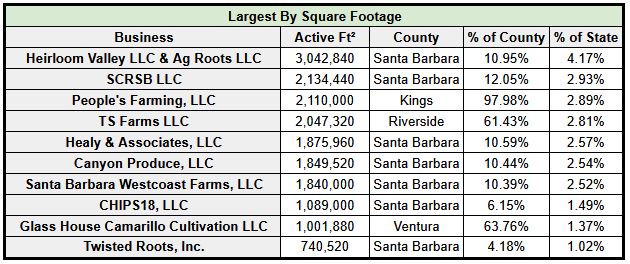
Speaking of concentrated ownership, who are all these big cannabis businesses? We pulled the numbers, and it turns out all the big players are almost entirely outdoor cultivation. Here’s a breakdown of the top 10 operators across the state by canopy area:
Special Findings About Some top Farms
We did some research, and found a few key pieces of info about some of these farms that change the top 10 results:
Heirloom Valley LLC and Ag Roots LLC: While they show up in State records as two separate businesses, these two huge farms just outside of Lompoc are owned by the same family and are right next door, with satellite images indicating they share facilities and a driveway. The owners run Pro Farms, so it’s likely that these farms supply that business. Therefore, it makes more sense to consider these to be one farm, which would make it the largest farm in the state by square footage (after perhaps the farm below).
Healy and Associates and Canyon Produce: These two farms have shared ownership. The only owner of Healy and Associates is also one of three owners listed for Canyon produce. Also, the farms are just a few miles apart West of Los Alamos. We can’t be certain that these farms operate as a single entity, so we don’t feel comfortable combining them in this ranking. If they were confirmed to operate together, this would make them the biggest farm in the state with over 3.7 million square feet of canopy.
GBH Cultivation LLC: This business initially ranked 8th overall statewide. All licenses associated with this business are now listed as “Limited Operations” meaning that the farm is not growing at full capacity. This usually indicates that the farm is on the way out of business or the owners are trying to cut their losses and sell it. While we consider this farm to still be “Active” since they can conduct some cultivation, farms in jeopardy like this shouldn’t really be considered in the top 10 so we have left it out.
If you’d like to do more research on these megafarms, here’s a list of links and information to start with:
And that’s all for this report! We’ve looked at the trends in licensing and square footage since legalization, regional concentrations of different types, large licenses, and the biggest farms in the state. We’re always happy to dig into the data, so if there’s anything you want to know that we didn’t include, let us know and we’ll add it! Stay tuned for more reports in the near future on the commercial and manufacturing sectors of the industry, followed by some more in depth reporting on a few other hot topics.
Higher Origins exists to get small cannabis farms to market. Insights like these are a way for us and our readers to better understand the market so we can help small farms in the most informed way possible. If you are a licensed California cannabis operator and would like to source from small farms, or if you own a small farm yourself and would like to get your products out into the market more easily at a better price, sign up for Higher Origins. Signup is free and gets you a professional menu tool, the Marketplace, ordering, a public profile page to tell your story, and more! If you appreciate what you’ve read today, tell your friends and share it far and wide! We can all agree that the California cannabis industry desperately needs more informed and thoughtful decision making, and insights like these can help.
Thanks for reading, and stay tuned for the next one!
-The Higher Origins Team
Comments (0)
No comments yet. Be the first to join the conversation.
Insights on the cultivation sector of the California Cannabis Industry, from 2018 to 2026. Covers trends in indoor, outdoor, and mixed light by county, as well as license counts, large licenses, and major businesses.
A report on the trends in Manufacturing licensing in California's cannabis industry, across volatile and non-volatile licensing, packaging, infusion, and shared use facilities. Trends are analyzed at the county and statewide levels.
The Mendocino County government has created a bureaucratic nightmare for cannabis operators through high fees, unfair taxes, and complicated permitting. These obstacles should be removed in order to boost the local economy.
Covers the details of a pilot legislative draft that would allow small farms to ship legal cannabis to consumers with the goal of stabilizing the California industry, increasing access and revenue
A report on the trends in Manufacturing licensing in California's cannabis industry, across volatile and non-volatile licensing, packaging, infusion, and shared use facilities. Trends are analyzed at the county and statewide levels.
The Mendo Cup is a cannabis contest for sungrown outdoor organic flower grown in California's Mendocino County. The contest honors the traditional growing and breeding of cannabis and returns its proceeds to the growing community.
HigherOrigins
Are you 21 or older?
By continuing, you acknowledge that you have read, understood, and agree to our terms of use and privacy policy.

Comments (0)
No comments yet. Be the first to join the conversation.