…
A Small Farm Focused Proposal for Direct to Consumer Cannabis Shipping in CA
A simplified summary of a new legislative proposal to allow small farm and co-op direct to consumer cannabis shipping in California, including goals, legal challenges, guidelines, and how the system would work

Higher Origins Published Oct 29, 2026 · 11 min read
A while back, we wrote a proposal for legislation that would allow small cannabis farms to ship legal cannabis within California. After a lot of research, data gathering, talking to fellow cannabis industry people, and good old fashioned arguing, we came up with a much more refined version of this proposal. There's a lot of things different from our last attempt, but we think this one is significantly better and more workable. Namely, this one takes into account actual laws, legal precedents, and the viewpoints of multiple different industry players. It's not perfect, it will probably have it's strong opponents, and it has a lot farther to go and a lot more work to be done on it by people who are better at this than we are. Still, we're quite happy with what we've cooked here, and would love your feedback or support!
This is the plain English abridged version of our official Legislative Proposal and Technical Overview, which are both very dense and technical and hard to read on your lunch break. Sources, rule references, and exceptions are left out here to keep it short. See the other two documents for the full details. Also check out our Direct Access to Small Farms page for a ton of information and research that we've done on this topic.
The problem
Small cannabis farms in California are in financial trouble because they are often shut out of the State's distribution supply chain by middlemen, artificially depressed market prices, or geography. A farm can follow every rule and grow a good crop yet earn too little to stay in business. Separately, about 60% of California counties don't allow retail stores. Residents there can get cannabis delivered, but only from nearby delivery services.
The proposal
We propose letting farms with 10,000 square feet of canopy (plant-growing area) or less, and co-ops that own their own distributor, ship cannabis they grew directly to consumers through approved package carriers. The Department of Cannabis Control (DCC) would grant this through a shipping "endorsement" added to a qualifying farm's existing license. Existing rules for testing, taxes, and ID checks still apply, and farms can keep selling the way they do today.
The law should:
Let endorsed farms and co-ops ship their own cannabis via package carriers. Only cannabis grown on the farm, or by co-op members, is eligible.
Cover farms with up to 10,000 square feet of approved canopy, counted across businesses under the same ownership. A co-op needs at least three independent farms and may have no more than 4 acres of canopy in total. A co-op-owned distributor can be endorsed as a central shipping hub for all its members.
Include indoor, outdoor, and mixed-light grows, as well as specialty and cottage farms, nurseries, processors, and farms under limited operations status. Licenses operating as microbusiness activities are eligible for the endorsement.
Make the endorsement part of the existing license, with no new local permit, no extra paperwork, and no additional operations to build.
Allow shipping only through carriers that use employees, stay within California, follow labor laws, and follow DCC delivery and operating rules.
Keep existing rules for taxes, refunds, recalls, customer privacy, and daily purchase limits. Online marketplaces may serve sellers, and refunds can come from ordinary business funds with no new mandatory reserve.
Fund the program, report costs and results to taxpayers (including effects on farms and workers), and draft the law to withstand legal challenges. No cap on participants, no expiration date, and no extra purchase limits.
What it could mean for farm income
A farm we work with reports that a 5,000-square-foot outdoor farm produces 300–500 pounds of finished cannabis. Wholesale distributors pay that farm around $400 a pound. Selling to dispensaries at $6 for an eighth brings in about $778 a pound, but with more overhead. A retail eighth usually costs $25 including tax. After 15% excise tax and 8.5% sales tax, the farm keeps $20.04.
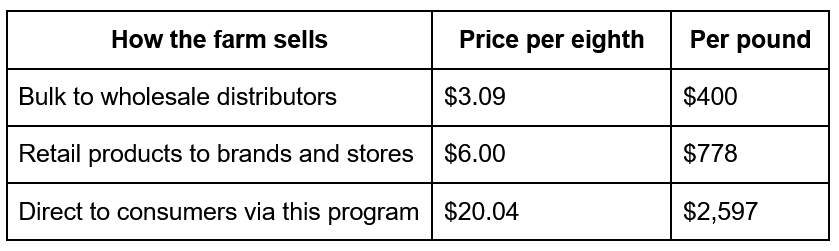
These figures come from one farm's experience and are before shipping, marketing, packaging, and other costs. Actual rates depend on the buyer and local taxes.
Selling directly rather than to retail would make the farm about $14 more per eighth, or $56 for four eighths, which helps cover shipping, marketing, and similar costs. If the excise rate rises to 19% on July 1, 2028, the farm would still make $13.36 more per eighth than selling to a retailer.
To reach $500,000 in revenue before costs, the farm would need to sell about 193 pounds, or 39%–64% of a 300–500 pound crop. An $80,000 manager would cost about 16% of that revenue. Selling the same 193 pounds to a wholesaler at $400 would bring in under $80,000 before costs.
This proposal won't raise income for everyone in the cannabis industry, and we need real-world numbers from more small farms to know what it could do.
How it works
Farms. The endorsement attaches to a farm's cultivation license and makes the farm the legal seller of its own cannabis. The farm takes orders and payments, stores and packs products, and hands packages to the carrier. It can use licensed labs, distributors, and manufacturers for testing, transport, and processing, then get the product back to ship. There may be a small endorsement fee.
Co-ops. The endorsement attaches to a licensed distributor or distributing microbusiness that the co-op legally owns. A contract with an outside distributor doesn't count. That hub ships only member-grown cannabis, can combine several members' products in one order, and can still distribute normally for other businesses. Co-ops are currently limited by the Business and Professions Code. The bill would update those rules for all California co-ops, endorsed or not, to allow all grow types and multiple licenses, with a 10,000 square foot maximum per member. Members must be natural persons who don't own cannabis businesses outside California. A person can belong to several co-ops, but their full canopy counts toward each co-op's 4-acre cap.
Microbusinesses (businesses combining at least three license activities) can qualify with a cultivation activity, or with a distribution activity if co-op owned. The endorsement doesn't count as an extra activity.
What's not allowed. Local delivery, unrestricted resale, farmstands, on-site consumption, and customer pickup from the seller's facility.
What can be shipped. Only cannabis grown by the farm, or by a co-op member. Buying, processing, packaging, or branding someone else's cannabis doesn't make it eligible. Seeds and immature plants from other growers can be used to grow eligible cannabis. Everything must meet current testing, quality, packaging, labeling, and quantity rules. The Technical Overview covers ownership, canopy counting, clone and seed sales, and manufacturing.
Staying eligible. Endorsements last as long as the attached license is valid and eligible. They renew with that license, and the DCC reviews material changes in between. Losing eligibility stops shipping, with no grandfathering.
Legal fixes needed. The bill must allow endorsed farms to send product to distributors for testing and get finished goods back for shipping, and must set rules for live nursery plants, which current law limits.
Safeguards
Alcohol shipping is a useful template for the rules below.
Age and ID checks. Recreational customers must be verified as 21 or older at order and at delivery. Medical customers must be a confirmed patient or verified caregiver aged 18 or older, with a valid medical card or recommendation provided at ordering. Sellers verify ID and medical paperwork before shipping. The carrier checks ID against the order and collects an adult signature. Unattended delivery, package lockers, signature waivers, and redirects are not allowed. Pickup at a carrier's shipping office, which the DCC reviews first and which isn't a retailer, still requires a signature and age check.
Failed deliveries and refunds. Sellers handle refunds for failed deliveries and lost packages. If the seller or carrier caused the problem, they owe a refund or replacement. Sellers don't need reserves, escrow, extra bonds, net-worth tests, or credit lines. Unopened undelivered packages can be returned and resold. Consumer returns can't be resold.
Recalls. If the DCC recalls a product, sellers notify everyone who received it and tell them what to do.
Tracking and taxes. Sellers log each shipment in the State's tracking system (METRC) when the carrier picks it up. Carriers report the outcome within one day, and theft, loss, diversion, or security breaches go to the State within 24 hours. Sellers register for, collect, report, and pay applicable retail taxes.
Online sales. Marketplaces and software companies can provide storefronts, payments, and shipping records without special licensing or status. Current marketplace rules apply to advertising, medical disclosures, and financial practices. Listings show the grower's name and license. Current daily purchase limits apply to online orders, and the DCC would need to clarify how.
Carriers and workers
Any qualifying California-licensed road carrier that provides residential door-to-door delivery for hire can apply. Carriers submit an operating plan to the DCC covering routes, returns, driver training, incident reporting, and ID checks. The DCC checks agreements, sites, California-only routes, secure custody, training, and insurance that expressly covers cannabis and employee risks. A willing, insured carrier must be approved before the program can fully launch.
Carriers follow California labor laws, including the requirement that cannabis businesses with more than ten employees must sign a labor peace agreement. Their employees can make cannabis deliveries, subcontractors need separate approval, and gig contractors are not allowed.
Cannabis remains federally illegal. California approval gives no federal permission or immunity, and federal courts keep authority. How state approval fits with federal limits is an open question for legislators.
Local governments
Existing local permits are enough to get the endorsement. Additional local rules can't block the State from issuing it, which requires a small change to current law covering only endorsed shipping activities. Local governments keep oversight of farms and distribution premises. New operations, upgrades, and new carrier facilities still need local approval. A legal consumer could receive shipped cannabis anywhere in the State, regardless of local cannabis rules.
Who might object
Retailers may object that endorsed farms reach consumers without full retail licensing. That shortcut is intentional: size limits, organizational requirements, and operating costs keep it narrow, while testing, taxes, refunds, age checks, and enforcement still apply. Retailers and distributors can continue delivery, curation, and farm partnerships.
Local governments may oppose the bypass of their authority and their inability to block shipments. They keep control over the facilities listed above, and new farms and hubs still need county permits.
Youth-access advocates will want evidence that age verification works well enough to limit underage access.
Where this has been tried
AB 1332 passed 39–0 in the Senate and 78–0 in the Assembly in 2025. It would have let a limited number of licensed businesses ship to a limited number of medical patients. Governor Newsom vetoed it, citing administration, tracking, product restrictions, and few eligible businesses. The DCC estimated, without published details, that it would have cost $269,000 to start, $472,000 a year, and a year to implement.
Challenges and next steps
This will take political coalition building. Package carriers must agree to ship cannabis, which may require changes to the proposal, and approval will take time before any shipping begins.
The DCC would publish application checklists, decide standard applications within 30 days and complex ones within 90, and reuse existing environmental reviews and records where possible. The DCC would report annually on progress, and an independent public review of economic performance would follow two years after the first lawful shipment.
Next, California Legislative Counsel would need to research, budget, and draft a bill with support from legislators, unions, businesses, and the cannabis industry. Sponsors would then test prices, legal agreements, and operating models to build the evidence needed for a vote. The Technical Overview explains the legislative process.
You can help! Share this proposal or the other two documents with others in the cannabis community, tell your representative or assembly member about it, promote it to related business groups, or reach out to us to collaborate! You can reach us at [email protected]
This legislative proposal and associated document are brand new as of October 2026.
We'll keep working on this while the harvest cures! Don't forget to vote!
-The Higher Origins Team
AI Disclosure: AI tools were used during the research of this proposal. All generated content and cited sources were extensively reviewed and corroborated by human editors and subject matter experts.

Comments (0)
No comments yet. Be the first to join the conversation.